

The Asociación Mexicana de Periodistas y Directores de Medios Agropecuarios (AMEXMA) hosted about two dozen IFAJ Executive members and journalists in Mexico’s historic highland city of Guadalajara in February for the 2023 IFAJ Executive winter meeting and tours of farms and processing facilities in the Mexican state of Jalisco.
The Executive meeting was officially called to order by Jalisco Secretary of Agriculture and Rural Development Ana Lucia Camacho Sevilla. Secretary Camacho welcomed IFAJ to her state—which produces 15 percent of the nation’s food, by value—and noted that “the media, and in particular agri-food journalism, are the best allies to shorten the distance between the countryside and the city. They are our best tool for rural connectivity.”

Jalisco Secretary of Agriculture and Rural Development Ana Lucia Camacho Sevilla is a policymaker, leader, and accomplished rider. She met with IFAJ and AMEXMA after an exhibition of her precision horseback riding team.
AMEXMA President Andres Canales Leaño, who organized the event with AMEXMA Secretary Alberto Ruíz Fernandez and members of the Mexican guild, welcomed the IFAJ team and pointed out that the state of Jalisco has been modernizing and enlarging its agri-food sector, growing to become the nation’s leading agricultural state. With its great diversity of high-value products, including avocados, berries, and tequila, Jalisco was also a natural setting for exploring the T-MEC trade agreement linking the country with the U.S. and Canada.

Andres Leaño Canales, President of AMEXMA (left) and Alberto Ruíz Fernandez, the guild’s Secretary, led their guild’s effort to host IFAJ’s winter Executive meeting in Guadalajara, Jalisco, Mexico in February. Here, they are pictured on the campus of Univeridad Autonoma de Guadalajara.
Executive Meeting
The February 23 meeting—which included a Zoom link for Executives who did not travel to Mexico—was the first in-person winter meeting of the Executive since the start of the Covid pandemic. Executives were briefed on federation business and budget, the IFAJ Code of Conduct, and ideas for a professional education program, and voted on rules for participation in IFAJ. The day also included meetings of revitalized committees on professional development, membership, communications, host country liaison (future congresses), and finance.

Jalisco Secretary of Agriculture and Rural Development Ana Lucia Camacho Sevilla and IFAJ President Lena Johansson chat before the opening of the 2023 IFAJ Executive winter meeting. From left, Addy Rossi, IFAJ Secretary-General; Adrian Bell, IFAJ Treasurer; Andres Canales Leaño, President of AMEXMA; Secretary Camacho; President Johansson; Steve Werblow, IFAJ Vice President. [Photo: Nanette Giovaneli]
That evening, IFAJ President Lena Johansson helped AMEXMA officials present awards of recognition to two legendary Jalisco agricultural journalists, Gonzalo Leaño Reyes and Conrado Vásquez Martinez.
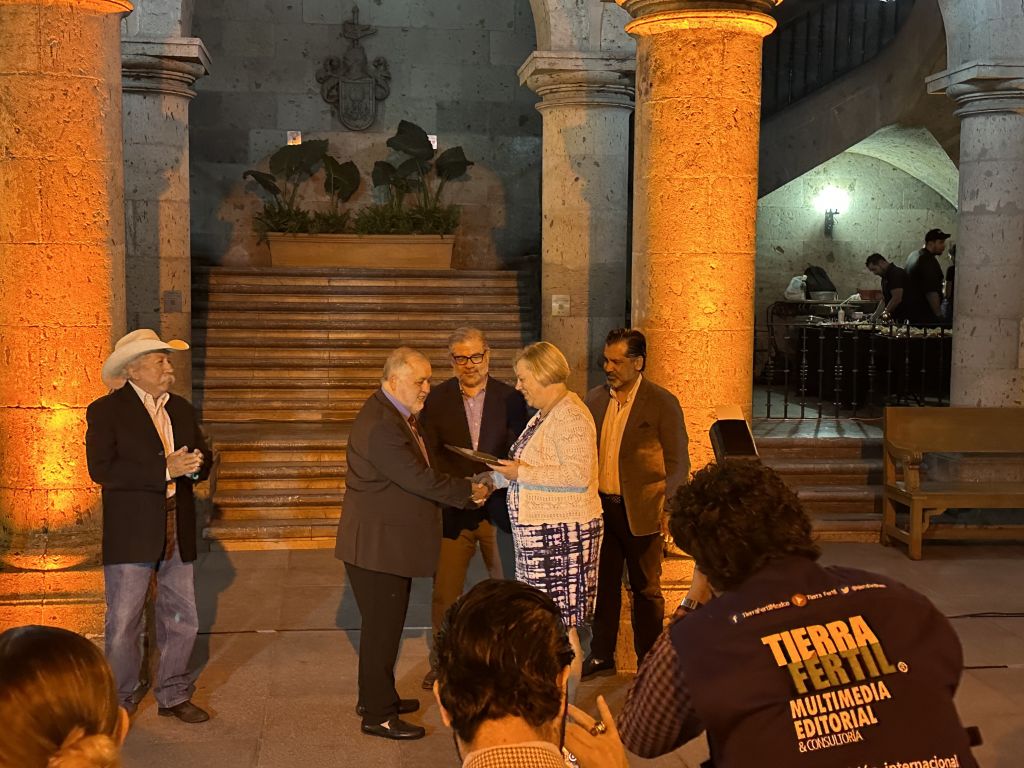
IFAJ President Lena Johansson congratulates Gonzalo Leaño Reyes in a ceremony at Guadalajara City Hall recognizing his lifetime of commitment to agricultural journalism.
World-Class Farms
Jalisco has its eyes firmly focused on export markets. In 2020, the state passed an agri-food law and invested in infrastructure. The tour AMEXMA arranged for IFAJ visited several world-class farms and processors.
Proan started as a family egg farm. Today, it is Mexico’s largest producer of protein, exporting a wide range of animal products to customers across Mexico as well as the U.S., Canada, Japan, South Korea and Hong Kong. The Romo family and its 900 employees’ daily production includes 5 million eggs, 3,000 pigs marketed as whole carcasses or cuts, 440,000 liters of milk, and tons of breads, pastries, and ice cream products from the spotless production plants on its huge campus in the city of Lagos de Moreno. Fueling the production, Proan’s feed mill produces 420 tons of mixed rations per hour, while the company’s biodigester turns methane from its farm and factory waste into renewable electricity.
At the Cerritos Group plant in Ciudad Guzmán, the group met the farm’s president, Saúl Medina, and his brother Javier Medina Villanueva, president of the Jalisco avocado packers association, APEAJAL. The Cerritos staff told the group about the company’s worker housing project, which provides safe, clean housing and social activities for the group’s workforce, many of whom come from southern Mexico. Saúl Medina led a tour through Cerritos’ pristine avocado processing facility, which packs 200,000 avocados per day. In one of the company’s avocado orchards, the Medina brothers described the expansion of the avocado industry into Jalisco, where producers have recently been allowed to export fruit into the U.S.

Avocado Tour—Saúl Medina leads IFAJ visitors through the Cerritos Group’s avocado packing plant, which processes 200,000 fruit per day for domestic and export markets.
The youthful staff of BerryMex introduced IFAJ reporters to the Guadalajara-based company’s biological pest control program, which includes the local production of essential oils, parasitoid insects, and beneficial fungi, as well as a progressive composting and vermiculture program. A short walk away, raspberry grower and BerryMex member Heriberto Ibarra described his family’s switch from conventional to organic production on their 30-hectare Vidahel Berries operation.
Agribusiness Leaders
The group toured the Bayer maize breeding facility in Tlajomulco de Zuñiga, where staff members detailed the company’s 20-year effort to develop the company’s Vitala System short-statured maize hybrids that improve grain yields and are more resilient to shifts in weather and climate. In the fading light of a long day of touring, Bayer team members also described the high-tech systems that streamline variety development—including analyzing the genetic fingerprint of every kernel of maize in the breeding program without destroying the seed—as well as cataloguing and shipping specific lines of maize to colleagues at breeding stations around the world.
Syngenta staff outlined the company’s High Value Corn Silage (Ensilado de Maíz de Alto Valor, or EMAV) program, which ties together highly productive hybrids and precision production practices to improve yields and nutritional value of silage and reduce feed costs by 30%. Patricia Toledo of Syngenta said the EMAV program increased milk output by 5 liters per cow.
Like whisky in Scotland or rum in the Caribbean, tequila is big agricultural business in Mexico. In the 2020-2021 marketing year, Mexico’s distillers exported USD $5 billion worth of tequila. Rudolfo Villaroel of the Tequila Regulatory Council described the industry’s system of product certification, quality standards, 18 regional appellations of origin, and its global anti-counterfeiting program. On the road to the city of Tequila, Jalisco, the heart of an industry that now includes portions of five Mexican states, the group saw the biggest indicator of the liquor’s power: vast fields of the Weber blue agave plant that have displaced the production of other crops such as maize.
To wrap up the visit, Luis Fernando Haro Encinas, Director General of Mexico’s National Agricultural Council, briefed the IFAJ group and Mexican journalists from across the country on the nation’s agricultural future. Haro provided special insight into ongoing T-MEC negotiations, emphasizing the need for science-based decisions in the wake of a presidential proclamation banning imports of genetically modified white corn for human consumption.
Haro’s presentation underscored the high stakes of trade talks to a nation that has built a world-class agriculture and food industry. The February program hosted by AMEXMA highlighted the skill, savvy, and commitment of Jalisco’s producers, and the professionalism of the nation’s press corps.

Luis Fernando Haro Encinas, Director General of Mexico’s National Agricultural Council (center), described his vision for the future of Mexican agriculture. He was flanked by Andres Canales Leaño, President of AMEXMA, and IFAJ President Lena Johansson.
Jalisco Agriculture Facts
Mexico is the world’s 12th largest food producer
Mexico is the 7th largest food exporter in the world, selling to 191 countries
Mexico is the #1 exporter of food to the United States and #2 food supplier to Canada
Jalisco state produces 15% of Mexico’s food, by value, worth more than USD $10.5 billion per year
Jalisco’s agricultural products include:
- Milk
- Eggs
- Berries
- Avocados
- Agave (for tequila and sweeteners)
- Sugar cane
- Tropical fruits (pineapple, mango, banana, coconuts)
- Maize
- Oregano
- Edible cactus paddles (nopales)
Jalisco is home to 60 media outlets that cover rural issues.
For great coverage of Jalisco agriculture and the farms visited during the tour, check out the March 2023 issue of Tierra Fertil magazine.