

By Steve Werblow
No matter whether you are snapping photos with your phone or swinging around a pro-level camera, capturing strong photos helps tell a story. Here are 10 quick tips to up your photography game (and make shooting pictures more fun, too).
1. Tell A Story
A nice picture of an interesting face can be an eye-catcher, but the best journalistic photos tell a story. Use details in your photo—the setting, the clothes, the action—to help illustrate what your subject does or how they relate to your story. Is there any doubt what the guy holding the chicken does for a living? I worked with an actor friend of mine to create the second image, which illustrated a story about depression among farmers.


2. Think Like A Film Director
Film directors unfold stories and maintain pace by switching from long shots to close-ups of key elements and then to medium shots…and back again, and they track a story from action to reaction. As journalists, we can do the same. After you’ve taken the necessary portrait of your subject, look for details for close-up images. Then look around to try to find some wide-angle shots that set the scene for your audience.


3. Look for Expressions
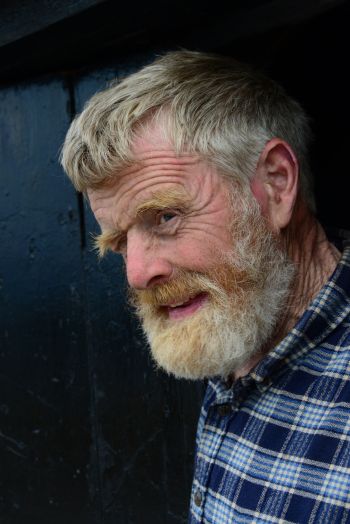
I like to interview my subjects before we start taking photos. Among the things I look for are the person’s candid expressions and movements. Capturing those is a great way to convey something about that person. In the case of this Scottish farmer, I noticed he had a frequent habit of putting his hand to his forehead after he completed a sentence. When we went to take portraits, of course, he put his hands down (first photo), so I asked him to “do that thing you do when you put your hand to your head.” He did, I captured it, and people who knew him and saw the photo immediately said, “Oh, that’s so Lawrence!”

4. Watch for Repeating Shapes
Wide or closeup, repeating shapes and geometric patterns can be visually compelling. Often, I’ll stand on a chair to photograph plated food from directly above, just to focus on the geometry and get away from the usual eye-level perspective. Turn a familiar scene into a bold graphic!


5. Emphasize Strong Lines
Bold diagonals grab the eye and draw it across an image. Look for ways to use leading lines—those strong diagonals—to add drama, direction and emphasis to a photo. They can be especially important in a busy scene, where viewers can benefit from some guidance about what’s important.


6. Look for Silhouettes
Like the old “I didn’t realize how beautiful the girl next door was” plot twist in romance movies, silhouettes are probably used too often…but that’s because it’s hard not to love them. Look for silhouette opportunities to give a bold new look to a familiar subject, or to tell a story in which the people’s individual identity is not important (or you don’t have photo releases for them). Silhouettes are not hard to shoot—just make sure your subject’s edge is in focus, then expose for the sky rather than the subject.


7. Get Closer
One of the things that makes many photos dull is that most of them are taken from 7 meters away at the photographer’s eye level. Make yours more interesting by taking two steps closer to your subject before you frame the photo. Or get even closer than that and show us a new view of a familiar subject, like the corn silks and pollen grains in this layout.

8. Get Low…Or High
Here’s that eye-level problem again. Make your photos pop by shooting from ground level or from high above the action. First, it’s a great way to add interest: compare the photo of fruit shoppers taken at ground level, then the same scene shot from a pedestrian overpass. Changing angles is also a great way to replace a cluttered background with a bold sky or ground.


9. Try Action
Emphasize movement by using a slow shutter speed to blur motion like the falling gravel in the construction photo, or to freeze action with a very fast shutter that highlights the moment the eagle grabbed its trainer’s food. Even phones and very basic cameras have “Sport” mode for high shutter speed—look for the running figure.


10. Get A Safety Shot
Most of us don’t get to do our portraits in perfect dawn or dusk lighting—in my experience, anyway, I’m all too often stuck trying to make a flattering portrait when the sun is directly overhead and shadows are falling all over the place, filling eyes with black smudges or blotting out portions of faces. Standing under trees can be tricky because leaves often create underexposed and overexposed blotches. Definitely try to tell the story with field shots, and use reflectors or fill flash if you can. But also make sure you grab a safety shot in nice, even lighting just in case. My favorite trick is opening a door—doesn’t matter if it’s a kitchen door, barn door, or garage door—and asking the subject to take half a step inside. That tends to eliminate (or at least minimize) shadows, and when you expose for the bright part of their face, whatever’s inside the building generally falls away to shadow. That adds drama, and the image is usually more flattering to the subject than squinting in the sun. (This doesn’t work as well for people with very dark hair…check out the photo of the woman in the blue Montna Farms shirt to see the limitation of this approach. For her, it would have worked better if I could have found some light behind her to create a highlight that outlined her hair.)
And that’s probably the best illustration of a simple fact: there’s always a reason and a chance to keep trying to take better photos!


Three of Steve Werblow’s photos have been awarded Photo of the Year by the American guild, the Agricultural Communicators Network, and he has been honored as runner-up for the organization’s Photographer of the Year.