

While North Kivu and South Kivu in the Democratic Republic of Congo remain in the grip of recurring armed conflicts, agricultural journalists who are members of the Association of Agricultural Journalists of Congo (AJAC) are bearing the brunt of the material and security consequences of this war. In the territories of Masisi, Nyiragongo, Rutshuru and Lubero in North Kivu, Kalehe in South Kivu, their equipment is destroyed, their radios silenced, and their lives threatened. An office of the National Coordination of AJAC ransacked in Goma. A dark picture revealed by the National Coordinator of AJAC, accompanied by poignant testimonies from displaced agricultural producers and journalists.
By Jean Baptiste, AJAC DRCongo
“Losses estimated at more than $100,000”: AJAC’s alarm call
Jean-Baptiste Musabyimana, National Coordinator of AJAC, draws up a damning assessment: “Since the resumption of clashes in 2022, 15 partner radio stations have been ransacked or occupied by armed groups in rural areas. Our members have lost cameras, recorders, and even reporting motorcycles. The material damage exceeds 100,000 US dollars.” He emphasizes that these losses paralyze the coverage of agricultural issues, which are nevertheless vital for millions of Congolese people who depend on this sector.
In the territory of Rutshuru, studios have been transformed into military bases, while in Masisi, equipment has been stolen or destroyed during targeted attacks. “Local radio stations, such as those in Kitshanga or Mweso, in Pamoja d’Alimbongo in the territory of Lubero were essential relays for informing farmers about cultivation techniques or markets. “Today, there is silence,” laments Jean-Baptiste.
Testimony of an agricultural producer: “Our fields have become battlefields”
Among the collateral victims, Samuel Mugenzi, a coffee producer in Rutshuru, says: “The fighting took everything: my crops, my tools, and even the training provided by local radio stations. Without information on prices or seeds, we are left to fend for ourselves.” His story reflects that of thousands of farmers whose land has become inaccessible due to the clashes between the Rwandan-backed AFC/M23 and self-defense groups known as Wazalendo, the FARDC and their foreign allies.
Displaced Journalists: Between Precarity and Resilience in Goma and Bukavu
In Goma, dozens of agricultural journalists have found refuge, fleeing the violence. Vianney Wasongya, a member of AJAC and agricultural journalist from Rutshuru, one of them, testifies: “We had to abandon our homes under fire. In Goma, even if we try to restart broadcasts, the means are lacking. Some colleagues survive by working as block leaders in displaced persons camps”. In Bukavu, the situation is not much better, Amani Mapendano, a displaced journalist from Minova in South Kivu, explains: “Local radio stations do not have the budgets to hire us. We depend on temporary projects, like those of Benevolencija, but that is not enough”.
A hostile security environment
Physical threats weigh on these professionals daily. According to the latest report by JED (Journalists in Danger), in 2024, 18 cases of violations of journalists’ rights were recorded in Goma, including death threats and attacks. “Working on agricultural issues also means denouncing the land grabbing by armed groups. This exposes us to reprisals,” confides a journalist on condition of anonymity.
Calls for help and glimmers of hope
Faced with this crisis, AJAC and its partners, such as Journalistes en Danger (JED) or the UNPC-CORACON consortium, are increasing training on security and advocating for international financial support. “We need funds to rehabilitate the AJAC national coordination office, rebuild radio stations and train journalists in new technologies,” insists Jean-Baptiste, AJAC National Coordinator.
Despite everything, local initiatives are emerging. In Goma, workshops bring together authorities and media to improve access to information, while projects such as Sauti ya Wahami, a program produced by traveling agricultural journalists are trying to give displaced people a voice again.

Office of the National Coordination of AJAC destroyed by the rebels.

Debris of the magazine “Wakulima Amkeni” produced by AJAC in collaboration with FOPAC NK.

Vianney Watsongo, agricultural journalist displaced from Rutshuru to Goma.
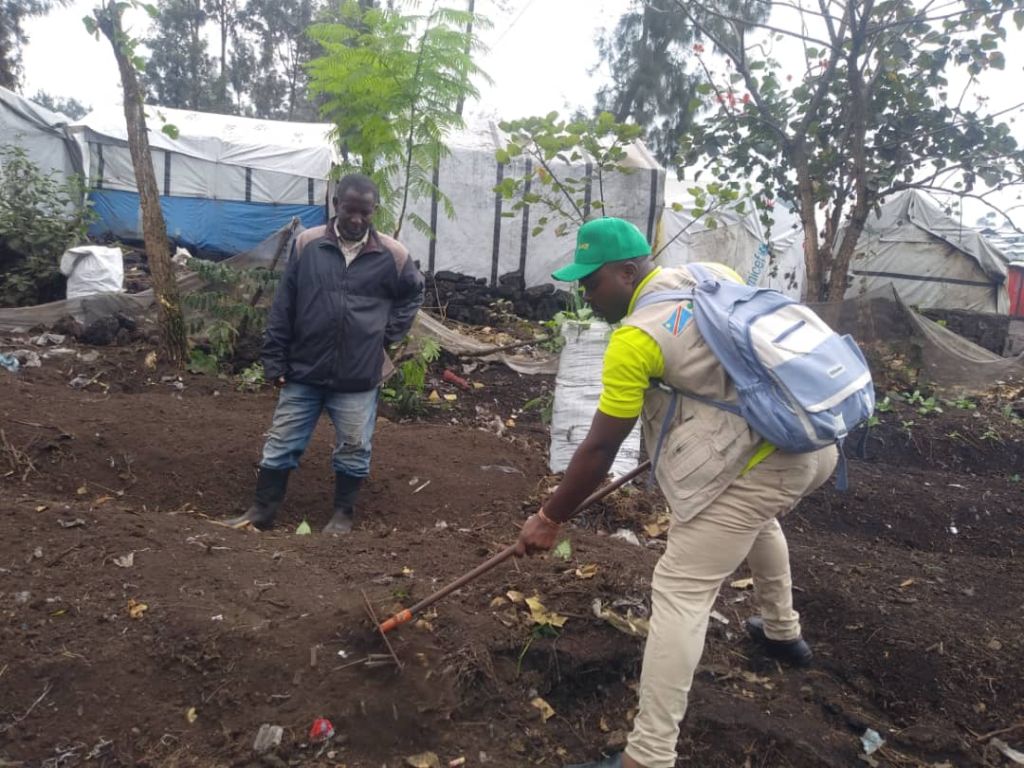
Vianney Watsongo, being resilient in his displaced persons camp in Goma.